

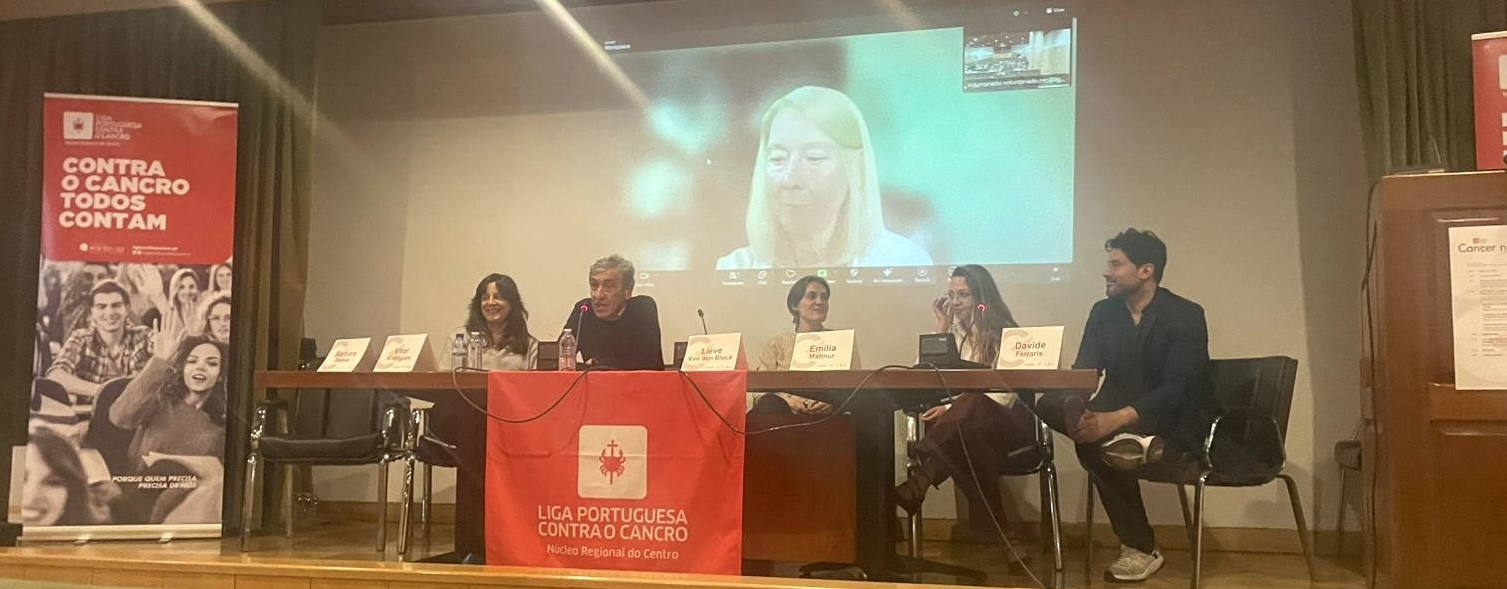
On 8 April 2026, the EU Navigate consortium gathered in Coimbra for the symposium “Cancer Navigation: Learning from Today to Shape the Future“, organised by the Liga Portuguesa Contra o Cancro and the Universidade de Coimbra. The event brought together researchers, volunteer coordinators and clinical partners from across the project to share experiences, emerging results and lessons learned from implementing cancer navigation programmes in six different European healthcare systems.
The morning session opened with a presentation by Maja Furlan de Brito (University of Coimbra) on preliminary outcomes from the Portuguese navigation programme, followed by a broader session chaired by Barbara Gomes and Vitor Rodrigues on EU Navigate’s results and challenges across Europe. Emilia Malmur (Jagiellonian University Medical College) shared experiences from Poland and beyond, and Lieve Van den Block (Vrije Universiteit Brussel), the project’s Project Coordinator, presented first results and plans for long-term sustainability. The afternoon featured a contribution from Barbara Pesut (University of British Columbia, Canada), the original Nav-CARE programme’s home institution, situating the European experience within the wider international navigation movement.
The Italian Virgilio Model
The Italian team, Davide Ferraris (Italian Principal Investigator, LILT Milano Monza Brianza), Chiara Lusetti (LILT Grant Office) and Silvia Cossa (Volunteer coordinator), presented the Virgilio Model: LILT Milano Monza Brianza’s programme in which specially trained volunteers accompany older people living with cancer throughout their illness trajectory. Just as the poet Virgil guided Dante through the unknown, the Virgilio volunteers serve as human guides, relational, emotional and practical companions, for patients navigating the experience of cancer in later life. The Italian whole volunteer programme currently counts 622 active volunteers delivering over 91,000 hours of support per year in Milano and Monza Brianza area.
Beyond Research: Navigators as Agents of Compassionate Communities
One of the most meaningful threads running through the symposium was a question that goes well beyond clinical trial design: what kind of society do we want to build around people living with serious illness?
Cancer navigation, at its best, is not only a healthcare intervention. It is a social movement. Volunteers who enter the life of an older person with cancer are not just filling a gap in the care system; they are reshaping the fabric of the community around that person, contributing to what the international literature calls compassionate communities, networks that collectively take responsibility for the experience of illness and loss rather than delegating it entirely to professionals.
More than 60% of new cancer diagnoses in the EU affect people over 65, and no health system alone can meet the relational needs of this population. What sustains these programmes in the long run is not only research evidence but a shared conviction, embedded in communities and institutions, that accompanying an older person with cancer is meaningful, valued and worth doing.
That is the social infrastructure EU Navigate, at its most ambitious, is contributing to build.
We are grateful to the Liga Portuguesa Contra o Cancro, the Universidade de Coimbra and all colleagues who made this day possible: Lieve Van den Block, Barbara Gomes, Emilia Malmur, Maja Furlan de Brito, Sónia Silva, Vitor Rodrigues and Barbara Pesut.
No one should face cancer alone, at any age. And no community should leave that task entirely to others.
Author: Davide Ferraris (Project Manager Italian partner EU NAVIGATE)


Comments are closed